Showing posts with label Miyazaki. Show all posts

2026-05-28

Curtiss R3C-0

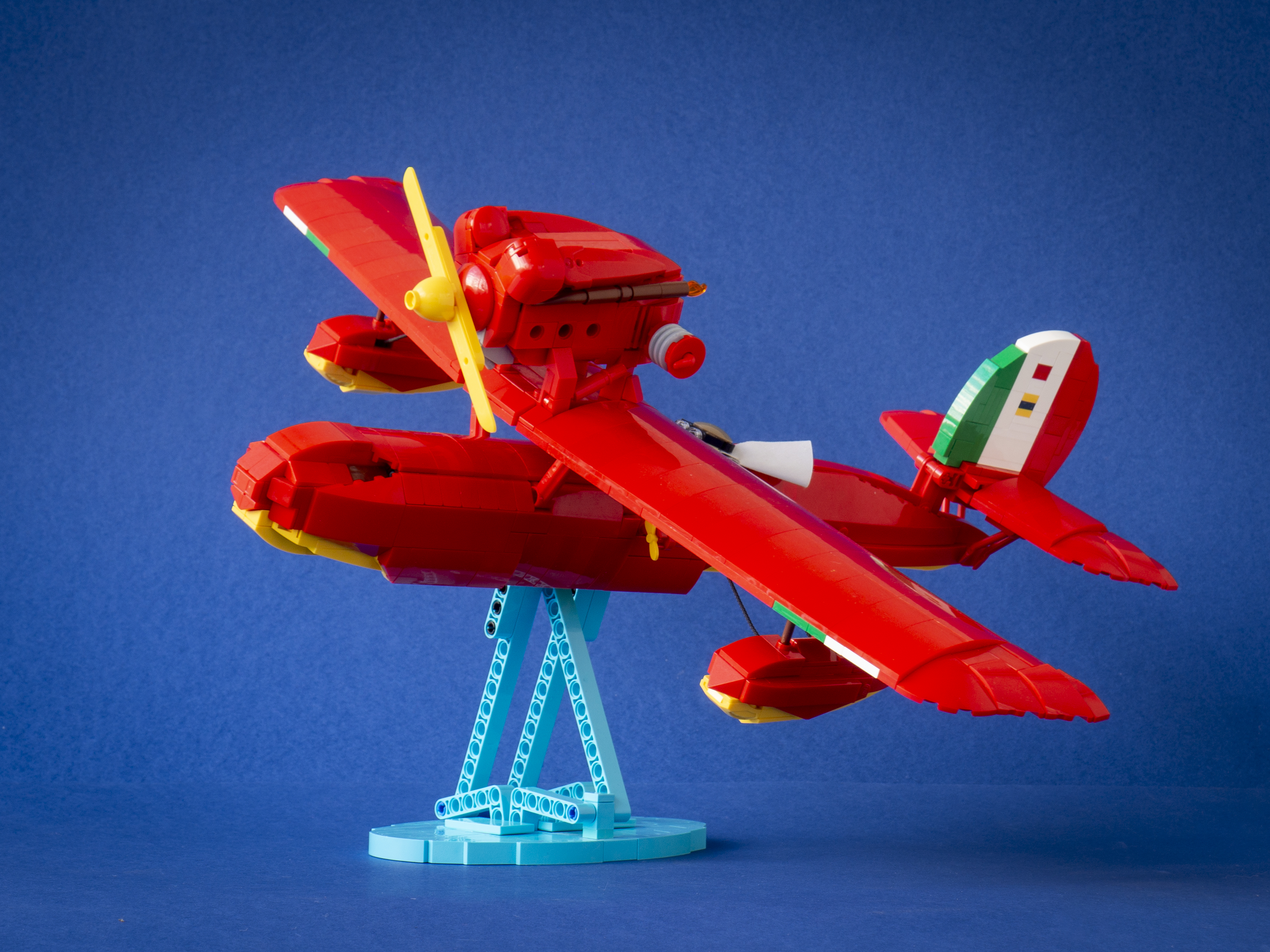
This is the second seaplane I built for my Pavilion of the Seaplane Association. The first was a real-world flying boat. Having cleared that, making a float plane (seaplane which hull does not touch the water) was a natural choice. They're less special and elegant that flying boats, although there are some really beutiful ones. However, it was easy to settle on Curtiss, famous from Porco Rosso. It is a real-life plane, American Curtiss R3C, armed with twin machine guns and with its wing-foil cooling system replaced with a radiator under the engine, like a jutting lower jaw (slightly misaligned in the photos with the stand). The real Curtiss was piloted by Jimmy Doolittle and beat the Macchi M.33 (last of the competing Italian flying boats) in 1925 Schneider Cup. This is references in Porco Rosso; Porco's rival Donald Curtis (with one s!) was inspired by Doolittle and Porco's fictional Savoia S-21 flying boat was inspired by Macchi M.33!

Porco Rosso is my favourite film, and as I had already built Porco's plane in miniland scale (and several times, too), giving some attention to Curtiss was a pleasure. The plane is easier that Savoia S-21, which is good as smaller scale has its challenges. This is strictly in minifig scale, although unable to fit in a minifig - they are so wide. With the wingspan of 25 studs, this isn't very big model. 

As there are no creative choices behind the process, it's hard to say very much about this. The pontoons were the most difficult part, and I'm not quite satisfied with them, but with the current rate there will be perfect curved slopes for them sooner or later. I'm happy how well the windscreen works, and with the white stripe behind the cockpit. The piping between the pontoons and the hull looks fragile, but is surprisingly sturdy. And finally, the 2x2 quarter round curved slopes from PaB elevated this to the next level - the photos of the Pavilion used baby bows with cut corners.

-Eero.


2024-12-26

Savoia S-21

 I've got no doubt that Hayao Miyazaki's Porco Rosso (1992) is my favourite film. I've built the signature seaplane four times; the first one (cirka 2008) was not documented, but my Brickshelf has a version from December 2009 that can't be much younger. I had the third version from 2015 intact until this summer and even had it in some retrospective exhibits last year. However, I had long realised that its proportions were severely off; I liked its wings, engine and tail, but the fuselage had the bulk of a bomber and I quite never achieved the desired shape of pontoons.

The idea of reshaping this is not new. I'm not sure what it took to finally actualise it after all this year. Nevertheless, I finished this already in July and displayed it in Pii Poo Helsinki event; then it just took some months to photograph it.
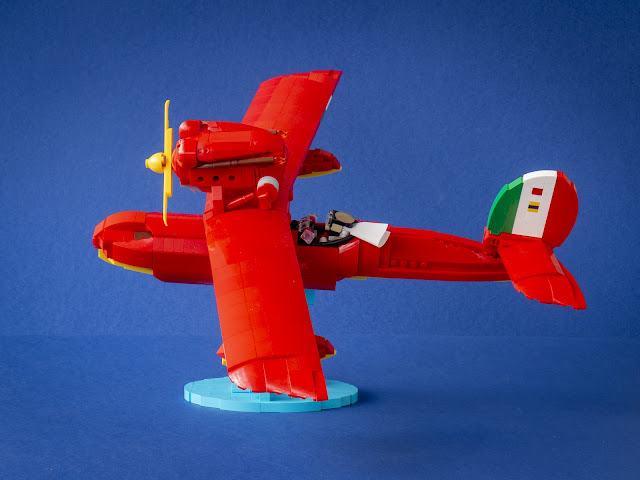
This time I took a very close look to the proportions of the actual plane. Savoia is a real manufacturer, and despite it weird looks, the plane is not that far-fetched. As well-know, the closest real-world paragon is Macchi M.33 (two of which were ever built). Monoplane flying boat fighters were very rare, as were ones where the cockpit was situated behind the wing and the engine. Porco's plane (which is a prototype barn-find, too dangerous to fly due to the take-off issues) takes this typology even further with having the wing elevanted above the fuselage; M.33 had the wing connected to the fuselage.
However, no physical Savoia S-21 has ever existed. Ghibli animators drew different proportions for different shots as there was no physical model to reference to; even "official" drawings partly visible in Art of Porco Rosso book feature clearly different measures of the fuselage ratios on the front and back of the wing. The position of the cockpit in relation to the stepped underside varies considerably. This is not an issue when watching the film, but when making a replica, I had to choose the best-looking (and the most common) alternative.

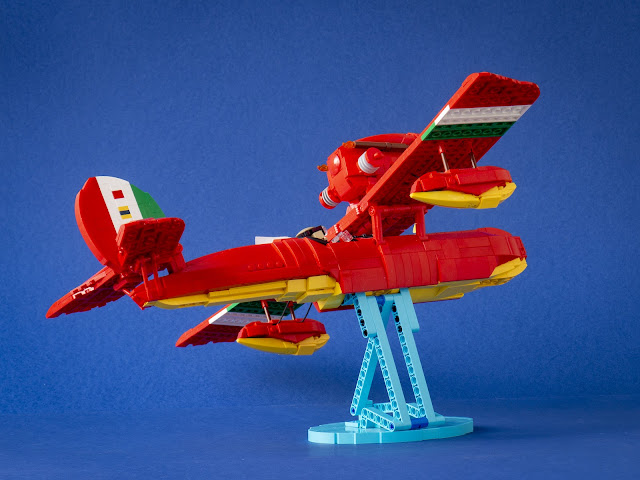
The first part of the design revolved around the so-called Porsche Bow (Wedge 10x2x2) that had been introduced recently in red. Ultimately Markus Rollbünder whom I asked for opinion was right - it was too big and long a piece, I had no hope of embedding the shooting slots with them on the nose. The finished design uses smaller pieces but benefits from other new wedges, which are most prominent in the wing tips. The back of the fuselage was the most challenging part of the whole model and took several re-designs. In addition to being elegant, I wanted to whole model to be sturdy enough for swooshing. This omitted to most free-form techniques, as there had to be continuous skeleton running though the tail. Despite this, the lowest red layer is angled with old finger joints. I'm particularly happy with the obscure Technic steering connector that connects the tail wing; it's very sturdy, and the crowbars are only a cosmetic elements.
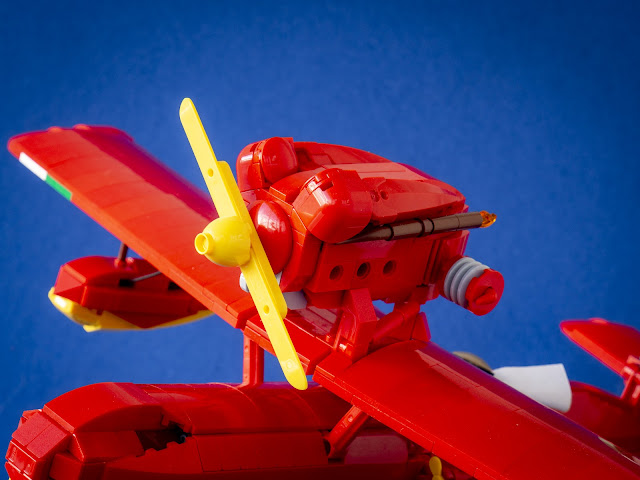
I was happy with the old engine, but this enabled some new developing of skill. Porco's engine has these two blob things, likely hiding the V12 pistons, that are rounded on the front and gently sloping and narrowing in the back. I liked their profile in the old engine, but they didn't narrow. Both of the essential parts here, 2x2 corner curved slope did not exist at all in 2015 and the Constraction claw with axle appeared in red only in 2020. Integrating them into the structure took some effort and the result is not entirely gapless, but it flows and has some new aerodynamics. The propellor spins freely.
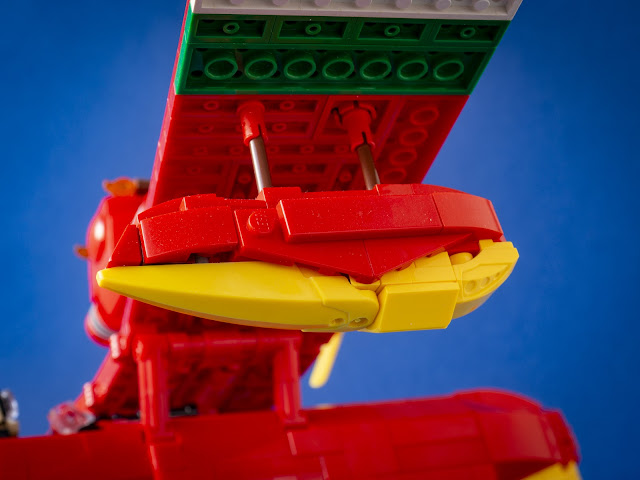
Again, the pontoons were a challenge, something that I left for the last moment. They still have some "polygons" - the shape is very difficult, especially with the curving border between the red and the yellow. The underside uses the same Constrastion claw, and oh boy it flows beautifully. I think it's more essential, as the top is mostly hidden under the wing. The wings itself are recycled from the 2015 version, though I redesigned the inner structure to house the new connections, and the wing tip is rebuilt with newer pieces.
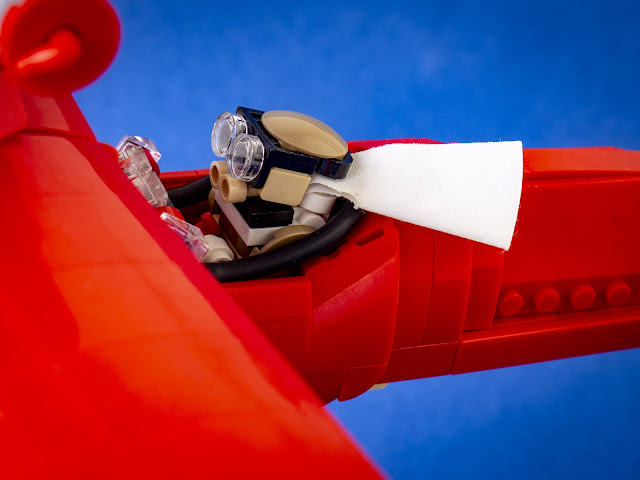
The previous version has a small Porco in the cockpit and I was not going to skip it here; I wanted to position the plane in mid-air (with a new, more marine base) and having it flying unoccupied would have had catastrophic consequences. While the cape scarf has been recycled from the previous one, the recoloured tan binoculars make sure that Porco Rosso looks better than ever.

-Eero.


2019-11-02

Master Yupa

This creation is a return to familiar subject: Hayao Miyazaki's Nausicaä of the Valley of the Wind, especially the manga. I've built six character builds about that masterpiece around four years ago. Their scale was little bigger than miniland scale, with bare, stylized faces and very limited articulation. I think some of them are good creations nevertheless, but they feel somewhat stiff, and as the source material is very close and inspiring, I recently chose to return to these characters, or at least one of them. The old models are still preserved somewhere in my wardrobe.

The man featured here is Master Yupa, greatest swordsman of Fukai, a mentor character in the comic book (and the film, of course). He has a cool uniform with cape and a brimmed hat with a tuft and pleasant looking boots; I don't remember the colours of the clothes in the film very clearly, and the manga is black-and-white, so this is more based on how I imagined the colours: Natural shades of uncolored wool, felt and leather. The pose, however, is the key point of the build. It is based on a panel on page 108 of volume II (Finnish version), where Yupa jumps to face his adversary in wormhandler's citadel. There is a very similar scene in the film, located in wormhandler's airship, if I remember correctly.  
Making a very specific, dynamic posing is unusual in my work. It posed plenty of fresh challenges. Making of this was inspired by a very specific piece: 6x6 quarter round slope thing. In August, I bought eight of those from Pii Poo in dark brown. Six is used there, and their shape forms the key areas of the flowing cape. Of course, they are big and thick chunks, so some "cheating" is made with the arms; they're connected with axles on ball joints, sticking out of the thin gaps inside the arches of those 6x6 bits. Yupa's impressive moustache hangs over the central one, making the distance between the head and the coat (or maybe it's a tunic) appear smaller. The rest of the cape is made with three more, and variety of dark brown curved and normal slopes.

Another key technique used here is 45 degree turns throughout the model. First one is between the head and the cape, using A-frame piece. Second is between the tunic and the cape, again using A-frames connecting to a hinge, as the cape is angled forward. Around the waist, there is another 45 degree turn, this time using custom turntable, stiffened with 3L axle with stud on end. I'm particularly happy with the belt buckle appearing between the hem of the tunic. The custom turntable was 4x4, which means Yupa's arse turned to be very square-shaped. It's rounded with some curved slopes, connected to ancient buffer piece. This creation was something like a three-dimensional puzzle, giving its geometrical difficulty, stability questions and incorporation of big, interesting pieces.

There were, of course, the usual aesthetic questions always important in character builds. Yupa's eyes are not seen in the original frame, and they're hidden under the brim of the hat (they don't really exist in the build). The hat uses 10x10 dish, which is quite rare - this one is from Pii Poo again and I'm happy the own one! The dome of the hat uses the same technique than my old Yupa. The barrel is connected with a ball joint, so it's slightly angles. The tuft is new, using dark brown grass pieces (I got 25 from LUGBULK and this is the first time I use any). Yupa has his moustache, an important character trait, and it consists of four 1x2 curved slopes, offset for flowing effect. The gloves are classic design from 2015 or something, but connected to an unusual angle, true to reference material. The swords are think brick-built ones. I wonder if I should have turned the anti-stud side hidden in the photos, but that might have been cheating... The scabbard was a very late addition, but true to the sources again.

This might just be my first character build to feature a jumping person. Flying Palutena built for Iron Builder might be the closest. Being static in mid-air required a base. The first one used a transparent beam made of 1x2x2 panels in trans-clear, but it was too weak. Four 1x2x5 bricks worked much better. They were all I had, but fortunately I got more from LEGO House's PaB later on. As ten bricks wasn't enough height, I added some pieces of wormhandles machinery to the base; round, organic shapes with some suspicious piping. The base itself is a block of tan pieces. Inside there are four boat weight blocks, keeping the point of balance low and thus making the model safer to display. I think it's also worth noting that the the figure rests on single 1x2 brick hinge (with four studs on top). Helppo nakki, as they say here.

-Eero.