2022-11-23

Lydia Frenckell


This saxophonist started with a pair of legs, with the intention of using dark brown as stockings. It wasn't very easy, giving the limited number of parts available in this colour (still about 14 years after it debuted). Fortunately, the black joints don't jump out too much and the ankle rings of the heeled shoes make the ankle connections - small ball joint with a bar into the blocked stud of the 1x2x3 slope - sturdy enough to support the character. 

Playing the sax takes both hands and a mouth, and I didn't want the playing poses look too rigid.There is a ball joint below the bust, allowing more natural jamming stances. It makes the upper torso a bit too fragile, but I suppose it is worth it; I wanted the neck line to match the line with the tan inverter arches below, and this led to half-plate gaps inside. I'm rather happy with the Friends horse bridle as the top strap; it connects nicely around a 2x2 round brick, and its shape matches the black macaroni tubes.

Lydia's outfit turned out to be very dramatic in its dark colours, so I balanced it with the big, gold (brass!) saxophone and the bright magenta hair. All the previous "rock'n'roll scale" musician characters had got black hair, but I didn't have any real reason to limit that; and black would have fused too much with the clothes! I was also probably running out with black hair ideas... Anyway, it's balloon panel hair again - maybe third time - but for the first time with the curves turned inside. I like the way the hair hugs the upper torso!

The saxophone is a relatively simple affair with few key parts; a stack of 1x1 round plates with handles, braced with some robot arms and bars forming the... well, the bits that are played, probably. Elephant trunk makes a perfect mouthpiece; my only gripe is the somewhat filled "output" dish, but there arent's any good alternatives! The wamr gold colour is balanced on the skirt and the shoulder furs, adding some blight to the outfit.

-Eero.


2022-11-16

Eithel Meristem

The story of this character began in summer 2020 when I was building Mangee Primula and came up with those bat boots, high and thin. They didn't really fit the character thematically, but I liked their silhouette and they ended up in the WIP box. Things that end up in WIP box don't have very good chances of being really used, ever, but this figure didn't need to stand, so the cool boots with their one-stud (or module) wide footprints worked nicely. 

But now I'm getting ahead of myself. This character, Eithel Meristem, was once again built for New Elementary, specifically my article on Dots adhesive patches. The point was that the patched can be stuck into things (with a strong layer of glue under a cover sheet) to decorate them with tiles. I didn't need to decorate objects, but I wanted to try something new on a display methods aka have a model under of a shelf, not on top of it. I stuck one patch into the underside of my pinewood Lundia shelf and built Eithel who's sitting in a swing, not unlike those on elementary schoolyards. 

The best part on this idea was that I was up to build a sitting character, something I haven't done often; Hans Langseth comes to mind. Having a fixed sitting figure meant I could build a skirt without the challenge of fitting a poseable pair of upper legs inside of it, which gave me significant freedom of design. I'm very happy how the finished skirt flows. Other than the dress and upper legs, the figure is technically similar to normal poseable figs; there is even a theoretical waist twist joint, though the jacket prevents it from turning.

I used light nougat pieces on the shirt/dress top for their novelty value; it's quite close to the skin colour of the figure, but as this hue is relatively common in real-world clothing it didn't bugger me. The leather jacket with its bat collar is a call-back to the boots, and the flower embroidery on the sleeves gives it some detail and colour. I'm rather happy with the aqua hair, and the earphone bow uses new opan trans-green tiles from the set. I used black earmuffs to balance the darks of the colour scheme; otherwise the head could have been too light.

The sswing itself is a 4x8 affair with two short System chains connecting into Bionicle chain on both sides. The model was fun to balance, and the boots and the small chain orientation could be used to adjust it. Balancing worked better with one hand holding the chain - though with no real connections; I find this amusing, as it's actually hard to stay on a real-life swing without holding the real-world chain with a real-world hand.

-Eero.


2022-10-26

The Milky Way / Speed of Light

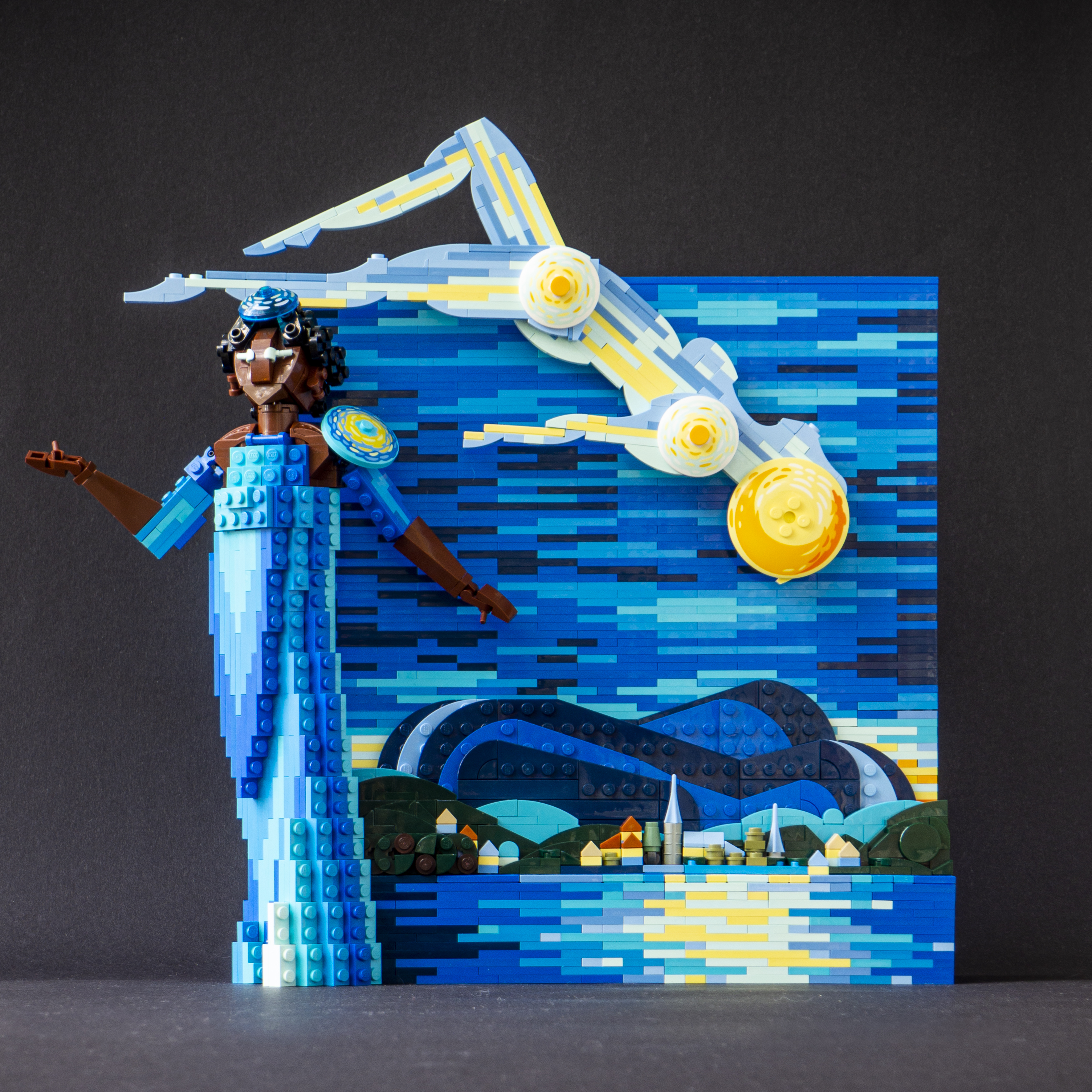
This MOC was inspired by 21333 Vincent van Gogh - The Starry Night set and built for an article about it on New Elementary. As you can read in it, is lovely set, likely my favourite ever - yes, even passing the nostalgia factor of childhood memories. I kept it build for a couple of months and then took it apart to build a MOC; I like to include a MOC on my New Elementary articles. For the first time ever I was solemn to do so. Maybe some day when I have a bigger home I'll rebuild it and hang it into a wall. It has a connector for that.

This MOC combines the 3D painting aspect with my usual character building. The colours are vital here, as the original set is an beautiful example of premium colour use on a model. This build uses mostly the same array of colours. I balanced the blues and yellows differently by adding the reflection of the moon to the water; the original Starry Night doesn't have any water in the landscape, but I think it fitted well, turning the village into a lakeside town. There's also the last (or first) shine of the daylight behind the fells on the background. In general, I think the scenery was inspired by some town in Northern Finland, with fells and a lake near by (there is always a lake). It was not deliberate to move the scene from The Netherlands to Finland, but then again, why not.

Most of the Starry Night set is plates, and I wanted to utilise there blue-hued plates to build an usually constructed figure in a dress. It is inspired by geysirs, the huge blasts of water rising from the ground due to geothermal activity. This made the figure relative simple, though there is plenty of SNOT inside! The figure is connected to the "painting" with two mixel ball joints, as those allow easy but very stable 90 degree grid changes, and are easy to include in a plate construction. I'm rather happy with the figure's hair.

There is also another human figure, also build mostly of plates, but mostly in two dimensions - a sort of link between the dress figure and the painting. She is the Milky Way, though I think the Finnish term Linnunrata  - The Route of Bird - captures the essence better. This figure also breaks the rectangular shape of the backdrop (which is mostly recycled from the set), creating a tension between the human-sized, town-sized and the galaxy-sized.

-Eero.


2022-10-16

AI Admiral

This is another collab model. The idea was to give an AI Looking Glass V1.4. some pictures and MOCs to generate an " average MOC designed by X" and then actually build it according to the image. I used similar photos of similar character builds to make coherent images, then picked the most interesting one. Here are some examples on the Looking Glass images:

Trust me, I didn't add here the most disturbing ones. I picked the one that was dubbed as The Admiral by Djok. It seemed to have a coherent consept, simple colour scheme and a pose with attitude:

As I perceived it, the character had a sort of half-trench coat, with tight trouser and sort of armour on another leg. There was definitely a high hat to compleate the uniform, some epaulettes and a red sleeve muff to warm the hands on windy decks. The color scheme was nice, lot of dark blue with some red and pearl gold. I began with the shoes, using a Hero Factory foot as a frame. The armour uses CCBS; the Chima pawn club attachs nicely to the CCBS shell! 

The next part was the coat, shaping the coattail and the bust with the insignia. The arms were the hardest part, as the angle had to be tigher than 90 degrees to be natural. The first version used the smallest CCBS shells with ball joints, but had too muech gaps. I solved it with SYSTEM. I finished the coat with a high collar to make the uniform look warm yet regal.

I added a sheathed sword, as it fitted the navy theme. The long straight object by the coattail leg on the AI image could be perceived as such. The hat was hard. I wanted to use those Chima Ultrabuild axe blades, but thei connection - merely an axle - is hard to connect on a free angle. I used a pull-out pin, which made the hat quite long; I wish they made axle hole/pin parts two-module long. I think it looks fine in the end. The earmuffs use stickered gear mechanism 2x2 round plates from Ninjago, which I fortunately had two of. They fit the dieselpunk aesthetics decently. 


2022-09-11

Baltasar Herbamare Plötz

 This is Baltasar Herbamare Plötz. He was built for a crab collab just tomorrow, but the character goes way back, maybe 6 or so years. He was my character on tabletop role playing game Shatterzone, vigorously reshaped from original shell designed partly by one Greg Farshtey. Well, anyway, Shatterzone is set in space and specifically in starship Minna Canth, piloted by drifter Jake McKorhonen with proud Ostrobothnian heredity. Baltasar (named after German baroqu architect Johann Balthasar Neuman) was the ships janitor, though he was a painter by profession (Shatterzone is realistic in a way; artists usually need another job). He solved the final conflict by painting a heroic rapper portrait of Martian biker mouse Verneri Vaderi, the story's antagonist, persuading him to be good again. More information can be found on Shatterzone Wiki.

I must confess this wasn't going to be Baltasar to start with. I was just making a crab (a pocket crab), with round shell and the eyes under it. Actually, the first shell wasn't this round, it used some angled tipper ends. They were bugger to connect, as they don't have any connection points inside! I finally replaced them with a X-pod dish, which worked much better. And the crab needed for some sort of theme... and the crab collab had many crabs, garder crabs, fortress crabs, robo crabs, but no painted crabs (I suppose) so Baltasar it was. I had to give him one big and one small pincer, as Baltasar is that sort of crab. The beret was easy, and the painting of Verneri Vaderi was fun to do. It must be noted that I made the original painting on watercolours during the game session; it's on the GM's apartment's hall wall. I know it because I saw it last Wednesday.

-Eero.


2022-09-03

Pohjoismaiden Osake-Pankki - Nordiska Aktie-Banken

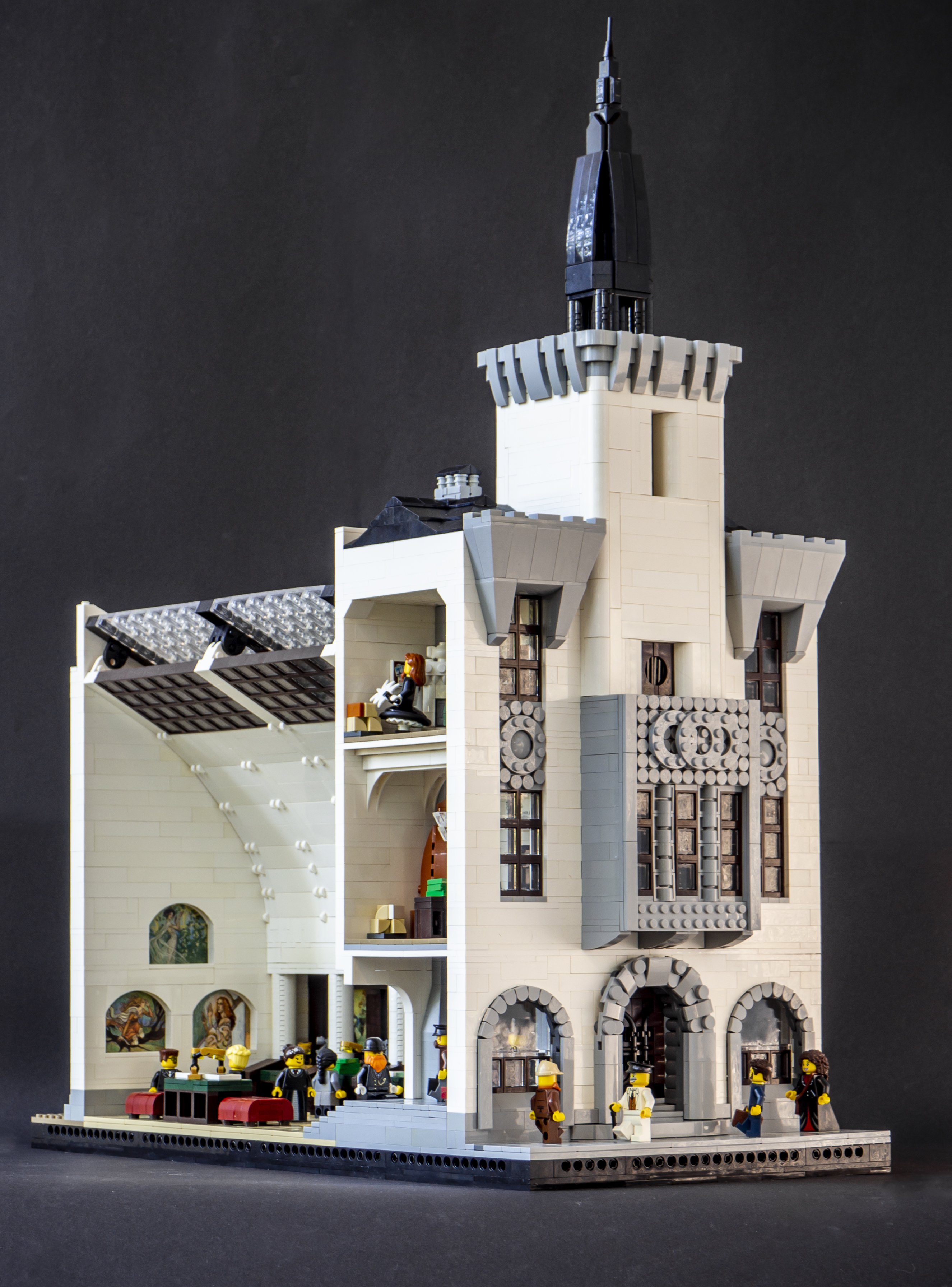
 This was my entry for Palikkatakomo ry's commercional building summer contest. The subject was simply a commercional building with footprint from 16x16 to 64x64. I had a clear intention from the beginning - to build my own version of architect office Gesellius, Lindgren, Saarinen's Pohjoismaiden Osake-Pankki bank from 1903-1904. I wanted to make a cross section of the banking hall and the vertical main facade. So the building is practically a three-dimensional axonometric cross-section. I haven't usually built interiors to my modulars, but I've grown interest in them, too, and this is the first finished one. I've got a much bigger, similar project in progress, too - as it has been for a year now.
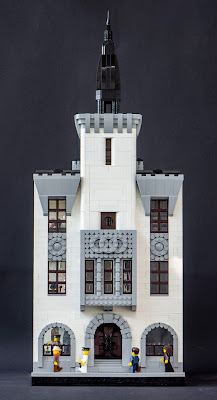
The main inspiration was Eliel Saarinen's watercolour sketch from 1903, showing a symmetrical facade with sharp-pointed tower and plastered surfaces with natural stone ornamentation. To building was not executed this way; the facade was built with smoothly hewn soapstone and the tower was omitted. The interior was glorius with pear tree furniture, skylights and rich ornamentation. The project was widely celebrated and was presented on international architecture magazines. It was demolished just 30 years later in 1930s to make room for Frosterus & Gripenberg's huge new bank building.

So this was my starting point. I did not want to copy the exact building or drawing, but to make my own version of it. Firstly, I had chosen to make the model 64x32 studs in size - 64x64 would have been too big job for the time I had got. This meant I had to abandon two of the five window axises, and the facade worked pretty nicely with these three vertical elements. I made a relatively finalised facade drawing (in Tikkurila train station and in train from there to Tampere) with measures - 3-4-3-4-4-4-3-4-3, 32 in total. The first-floor arches are made with tooth plates, soemthing I've wanted to try for a while. The tower has same smooth shapes than in Kudelma hotel, and stone armament... cheats a bit, mathematically, but works pleasantly nevertheless. I'm particularly happy with the stone ornaments between the 2nd and 3rd floor windows.

The frescoes of the bankin hall are not Lego so this is not purist work (gasp!). Our LUG's contest rules allow up to 1 % non-Lego-stuff in entries, and this one uses seven Magic the Gathering cards, illustrated by Rebecca Guay, much-adored artist of vintage Magic. Her work is very fitting for this jugendstil/Art Nouveau period, reminding of Alphonso Mucha or even Tampere-based Joseph Alanen. There cards - Samite Blessing, Sky Spirit, Dwell on the Past, Pulse of Llanowar, Quirion Trailblazer, Devout Harpist and Calming Verse - vary from unplayable to relative weak; but every one of them have beautiful art and I believe they work better here than in any of my decks. The art is almost exactly 6 studs wide, which made the integration very easy. The cards were not harmed during the build, they're simply contained inside the walls.

I kept the banking hall simpler and cleaner than the real counterpart. The vault is made with normal bricks, angled with swivel joints, and the skylights are done with using windows instead of bricks in the final segment. The actual roof in on top of the vault stucture as in the original; this is done simply with black bricks and transparent panels for the skylight. I think the vault is a bit too high; I added one 4-wide segment late in the process, but looking it now, it would have worked without. There is more than enought air and light in this semi-sacred space of capital.

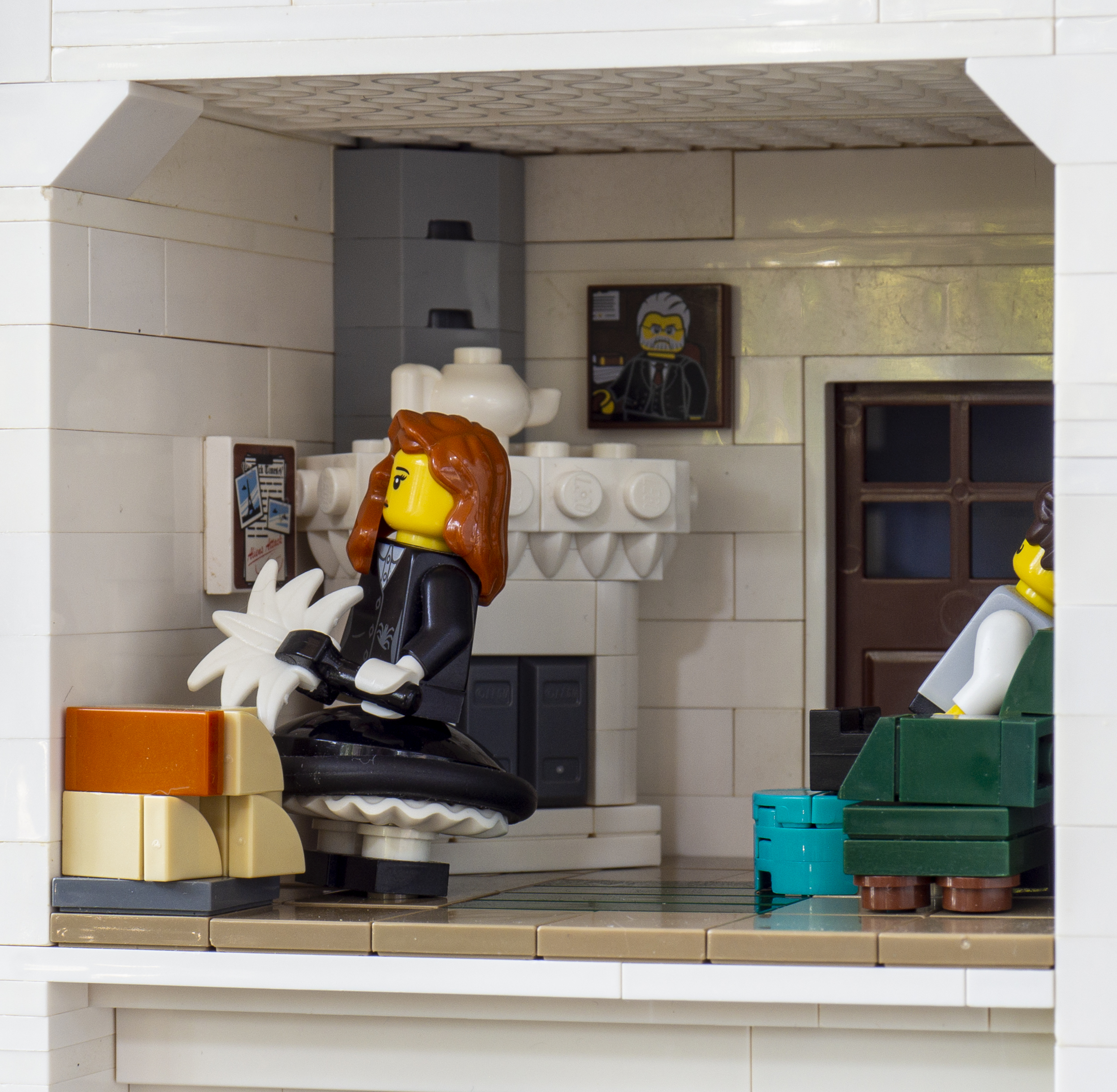
In addition to the hall, some of the spaces of the street building are cut and visible. The sturcture is unrealistically thin, but there are limits on what can be done in two weeks in 32x64 plot! On the first floor there is the bank manager's office, with tile stove based on a model designed by Valter Thomé around 1903; it was originally built for another project, but didn't quite fit. The third floor has the break room for bank staff, featuring a smaller stove. The first floor has simply a vestibyle leading to the banking hall, kept warm with a soapstone stove. 

 -Eero